The Importance of CSR in India’s Education System: Akshay Sharma Quick Note
India’s education system has been revolutionized by corporate social responsibility (CSR). Large-scale investments to set up schools and colleges and develop vocational training in the country are now commonplace. In this way, CSR programs provide equal learning opportunities and improve the quality of education. These programs also help kids prepare for the workplace and build community assets.Although CSR plays a significant role in elementary and intermediate education, professional study still needs many initiatives, according to Akshay Sharma AVS.
CSR and the Changing Narrative of Education in India: Beyond Philanthropy
For too many years now, educational CSR in India has focused primarily on counting the number of classrooms built, computers donated, and scholarships awarded. That measure is now evolving. As India’s education system moves from expanding access to improving learning outcomes, companies are investing in more initiatives to strengthen government schools, train teachers, improve employability, and build long-term relationships with public institutions.
Reliance has chosen education as one of the main focus areas for CSR. Reliance has multiple projects to fill various gaps, maintain a favorable learning environment, strengthen public education systems, and promote community engagement. Reliance’s projects aim to create an educational framework that enhances inclusive community engagement.
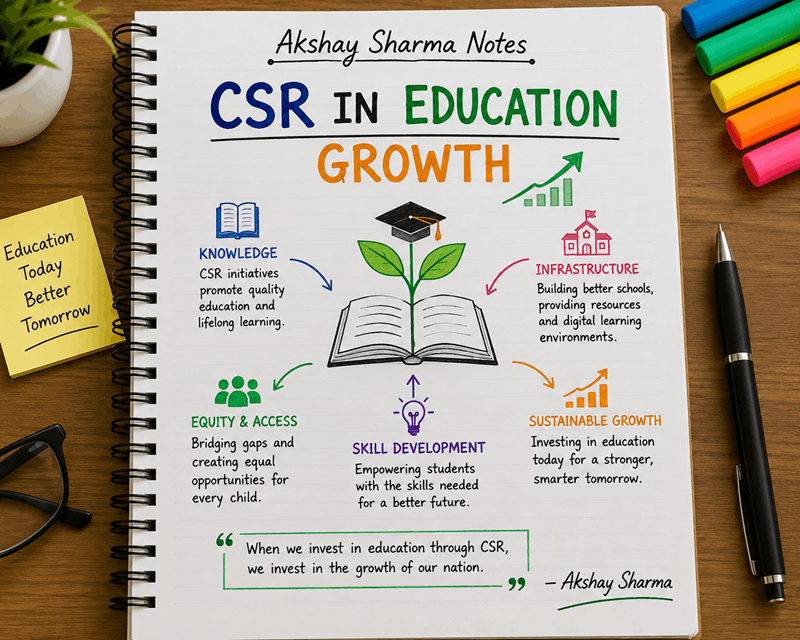
A hurdle is coming at a critical moment. India has been able to persuade children to go to school. According to UDISE+ 2024-2025, from a population of 24.7 crore children, India has 14.7 lakh schools and 1 crore teachers. The challenge is to make sure children learn. The number of Class III students in government schools who were able to read a Class II text increased from 16.3 percent to 23.4 percent in 2024, while the number who were able to solve subtraction increased from 20.2 percent to 27.6 percent.
According to the Annual Status of Education Report (ASER) 2024, progress is encouraging. However, it shows how far we still have to go.Akshay Sharma Kirti Nagar are not keen on praising CSR because of limited reachability.
Our two key objectives are to attain a 100 percent student enrolment target and to upgrade all rural government schools to the standard of urban private schools. We do this by providing the necessary support to develop a wide-ranging curriculum, sports and extra-curricular activities, ongoing teacher training and development, professional development, administrative training, capacity building, and infrastructure development (construction and renovation, libraries, school restrooms, etc.) and student enrolment initiatives at the grassroots level in collaboration with government programs.
There are government programs such as NIPUN Bharat, Samagra Shiksha, PM SHRI, and DIKSHA that aim to tackle this problem through basic literacy, teacher training, digital learning, and school infrastructure. However, given the size of the undertaking, governments cannot do it all on their own. In this respect, CSR is beginning to play a more prominent role.
Understanding CSR in the Indian Education System
Corporate social responsibility refers to business actions that benefit society. Under the Companies Act, 2013, eligible companies in India are encouraged to invest in social development. Under CSR, education remains one of the top priorities.
Also, companies collaborate with NGOs, government bodies, and academic institutions. They work together to improve teacher preparation, digital learning, and infrastructure. This means millions of pupils get improved educational materials.
The Significance of CSR in Indian Education
Education is the basis of national development, but many schools still lack enough classrooms, technology, and qualified teachers. Thus, CSR financing bridges these important gaps.
Corporate investment brings equal access to education. With CSR financing, students from disadvantaged and rural areas are given access to educational opportunities they have never had before. Therefore, educational disparity is gradually narrowed down.
Classrooms, computers, and scholarships have been traditional measurements of corporate social responsibility (CSR) in education. These measurements are changing. As the Indian education system moves from access to improving learning outcomes, companies are increasingly investing in initiatives that strengthen government schools, train teachers, improve employability, and establish long-standing relationships with public institutions.
The window of opportunity is narrow. India has been largely successful in getting children to school. According to UDISE+ 2024-2025, the country has 24.7 crore pupils, 14.7 lakh schools, and 1 crore teachers. Mark attended one of the rural public schools as part of the program.
The next challenge is to get children to learn. Mark attended one of the rural public schools as part of the program. The rest of the children are mainly learning by rote and struggle to grasp the basics.
According to ASER 2024, almost all children in India (98%) aged 6-14 are following the required school attendance rules. Also, almost all children aged 7+ can read and write.
The next goal is to get children to learn. ASER 2024 reported that more than 16.3% of Class III students in government schools could read a Class II-level text, and more than 20.2% could solve subtraction problems in 2022. As part of the program, Mark observed one of the rural public schools.
The percentage of Class III students in government schools who could read a text at the Class II level increased from 16.3 percent in 2022 to 23.4 percent in 2024.
Integrating children’s education means we address their academic performance, diet, personal hygiene, and healthy habits. We do medical check-ups and hold pulse polio camps, drinking water facilitation, and health and hygiene awareness camps sponsored by organizations. We also use initiatives like Day for the celebration of Yoga and Hand Washing Day to promote higher health and hygiene.
Our educational programs are offered to children from three to adults, especially to rural children in primary, secondary, vocational, and higher education. We also established adult literacy centers for girls and women and recognized the need for adult literacy in urban slums.
We focus mainly on basic literacy, teacher training, digital learning, and school infrastructure to address this problem. The government of India is addressing these issues through its various initiatives such as NIPUN Bharat, Samagra Shiksha, PM SHRI, DIKSHA, and so on. Yet, the scale of the undertaking is such that governments cannot do it all on their own. CSR is beginning to play a bigger role.
The Education System in India
CSR funding in India shows that the education sector is now the biggest spending segment. India Inc.’s total CSR expenditure in FY2024-2025 was Rs 40,794 crore, supporting more than 72,000 CSR projects. The education segment is the largest sector in the overall CSR outlay, contributing Rs 13,877 crore and accounting for 34% of the total. More importantly, companies are moving away from one-off donations towards multi-year commitments and partnerships with government and non-governmental organizations, and are taking an active role in outcome monitoring.
The Bharti Airtel Foundation makes an excellent example of this kind of change. The Foundation has stated that its programs and activities, as of FY 2024-2025, benefited over 22 lakh children across more than 16,000 schools. The combined initiatives and programs have benefited over 36,000 schools, over 330,000 teachers, and 3.7 million children.
The Foundation’s programs and projects aim to provide infrastructure support, as well as support for teachers, school improvement, incorporation of life skills, and community engagement. It operates a Quality Support Program in collaboration with school government agencies in 12 states, and a Satya Bharti School Program that supports 164 rural schools in 4 states.
Tata STRIVE is another company that has developed satellite programs in the employability space. It made a direct impact on more than 4.5 lakh youth through skill development, career counselling, vocational education, and entrepreneurship programs in FY 2024-2025, with a total outreach of more than 22.5 lakh beneficiaries. Outside the classroom, the focus is on ensuring that education translates into employment and economic engagement.
Key Areas for Promoting CSR Education
Educational Facilities
There are many corporations which build educational facilities, including laboratories, schools, libraries, and sanitary facilities. We appreciate improvements that create safe, healthy learning environments by providing clean, safe drinking water and electricity.
Students Academy
Students who attend comfortable, modern classrooms achieve better attendance rates, with positive, notable improvements.
Advanced Digital Learning
There is a considerable, fast trend towards the incorporation of the latest, advanced Information Technologies in education. Consequently, the CSR Funds are directed towards providing modern school facilities, installing secure Internet connections, stimulating interest in Digitalization by providing computers and iPads, and stimulating interest in self-learning by providing well-equipped Active Learning (AL) Classrooms.
Quality Educational Online Content
There is a great opportunity for schoolchildren to participate in numerous online enrichment and educational activities. There is high-quality educational online content that students access on Digital Learning Platforms. There is great potential for school teachers to enhance their professional skills and competencies in online and digital environments.
Training and Development of Teachers’ Professional Skills
Good, qualified teachers inspire and produce good, quality students. As a result, many CSR projects include professional development, educational training workshops, and courses.
This professional training will introduce the participants to the latest teaching strategies and modern educational theories.
Scholarships and Financial Aids
The CSR projects provide many opportunities that enable talented students to continue their schooling, a direct result of the lack of financial support. Many firms provide scholarships and grants to provide financial aid.
Many CSR projects provide financial aid through scholarships and grants for vocational and advanced training. As a result, many good students can do well academically, without having to worry about finances.
Employment and Skills Development
Employment cannot be guaranteed by
Students can gain technical skills and become computer- and communication-literate. They develop their problem-solving skills, self-confidence, and self-expression. Numerous organizations provide career counseling services and professionally supervised work placements. As a result, graduates are more employable.
- Benefits of corporate social responsibility (CSR) in education in India
- Sustained efforts of a company to support education through its CSR initiatives will improve the educational infrastructure in the country in the long run.
The Challenges of CSR in Education
- Many of the challenges that education faces are persisting, even with major improvements.
- Much of the rural school infrastructure still lacks adequate support services. Additionally, CSR funding initiatives typically focused on specific areas. Hence, little help was directed towards rural situations.
- Furthermore, ongoing monitoring is a critical component of sustainability. Many of the initiatives either peter out or become ineffective after the first stage of implementation. Hence, long-term structuring is necessary.
Successful CSR Education Programmes in India
There are innumerable companies based in India that have successfully implemented educational initiatives.
Numerous companies have provided support services to schools by implementing smart-class initiatives and digital learning centers. Many have started community mobilization and awareness programs to provide scholarships and subsidized scholarships to encourage girls’ literacy. Many companies also support teacher professional development, vocational training, and STEM education.Also find full details AVS Scholarship Program .